
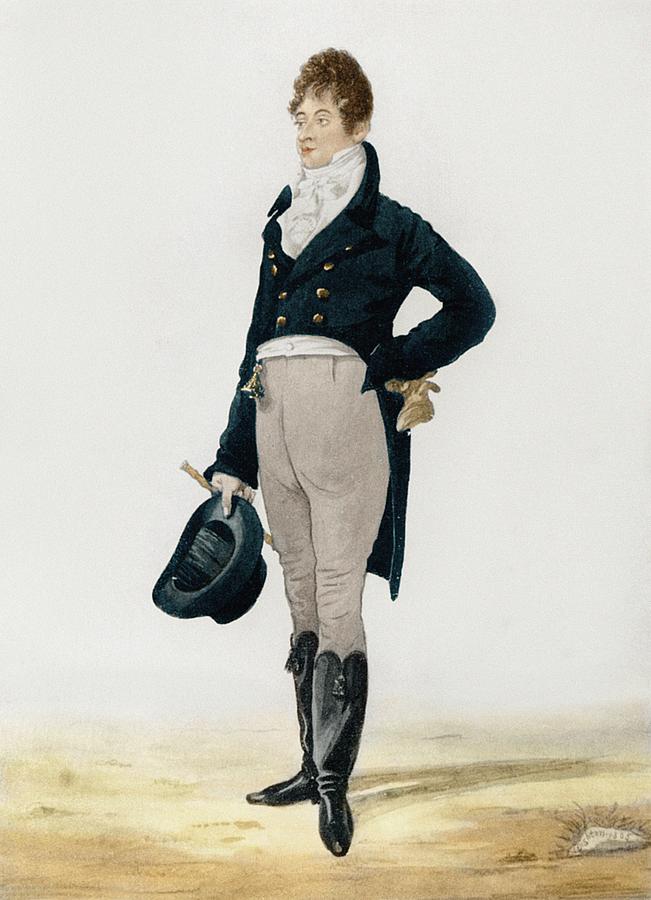
George Bryan Brummell was born in 1778 to an ambitious middle-class family, but through devastating wit, impeccable style, and supreme social confidence, he managed to elbow his way into the highest ranks of society.
This was the Regency era, the golden age of opulent, peacock-like male dress: brightly coloured silks, lace, jewels, and enough decorative flourishes to upholster a small palace. And powder. Lots and lots of powder. But Brummell wasn’t fully in a position to afford these extravagances and so he tried a different tack: he made perfect tailoring and refined elegance the new marker of status and, in the process, almost single-handedly reinvented men’s fashion. He rejected wigs, abandoned excessive ornamentation, and tossed out knee breeches in favor of full length trousers. In an age obsessed with excess, Brummell made quiet luxury revolutionary by embracing restrained colour, simplicity, and impeccable fit.
But clothes alone do not create a legend.
Brummell understood that style was as much about attitude as appearance. He treated fashion as performance art, reportedly taking up to five hours to dress each morning and polishing his boots with champagne. Whether these stories are true hardly matters. Brummell carefully cultivated an aura of effortless perfection, and people eagerly repeated every detail. Men copied not only his clothing but his grooming habits, mannerisms, and famously intricate cravats, spending hours trying to achieve the nonchalant elegance that he made look so easy.
He was, in every sense, the embodiment of the dandy.
Unfortunately, Brummell possessed one flaw that even perfect tailoring could not conceal: he was catastrophically bad with money. Gambling, overspending, and mounting debts slowly eroded his glamorous façade. And his situation took a nose-dive when his razor-sharp tongue cost him his most important friendship—that of the Prince Regent, the future George IV. In a society built on patronage and favour, falling out with the heir to the throne was tantamount to career suicide.
By 1816, pursued by creditors, Brummell fled to France. The man who had once dictated fashion to London’s elite spent his final years impoverished, disheveled and most likely suffering from syphilis. His death in 1840 went largely unnoticed.
Yet history has been kinder to Beau Brummell than his contemporaries. His vision of elegant menswear with its full length trousers, subdued colours and stylish jackets shapes the way men dress even today. And he innately understood something centuries ahead of his time: image is power, and carefully cultivated mystique can be every bit as valuable as talent. Beau Brummell was the world’s first fashion influencer. And he managed to do it without Instagram.