Remember, remember the 5th of November,
Gunpowder, treason and plot
I see no reason
Why gunpowder treason
Should ever be forgot.
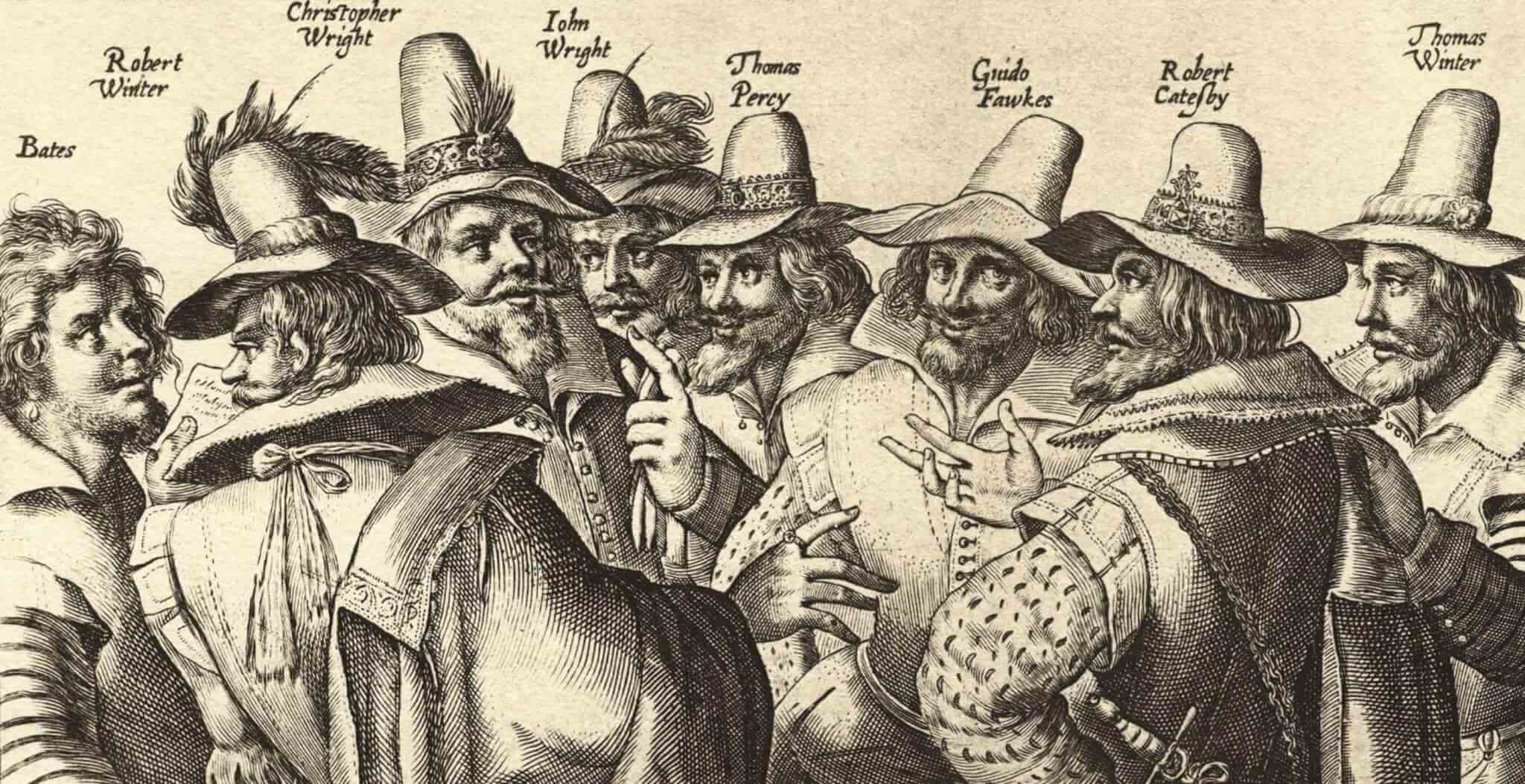
On this day in 1605, a treasonous attempt to assassinate the King of England by blowing up the Houses of Parliament, was foiled. The dastardly masterminds behind this little exercise in political grievance were Robert Catesby, Thomas Winter, Thomas Percy, John Wright, and the soon-to-be-famous-through-the-ages, Guy Fawkes. All were disgruntled Roman Catholics furious with King James I for failing to show greater tolerance towards their religion. He was, after all, the son of Mary, Queen of Scots, herself a devout Catholic, so perhaps a wee bit more religious understanding wouldn’t have gone amiss.
So, thoroughly cheesed off, the conspirators hatched a plot to blow Parliament sky-high while the King, his family, and much of the political establishment would be in attendance for its ceremonial opening. The idea was that, amid the ensuing carnage and confusion, the conspirators would rally a crowd of supporters, seize control of the country and install a new regime. An audacious, one might say, incendiary, plan.
And so the group, who by this point had grown to 13 people, installed 36 barrels of gunpowder, ferried across the Thames under cover of darkness, in a vault under the House of Lords. It was then Guy Fawkes, as a former soldier and gunpowder expert, who was tasked with babysitting the barrels overnight on the evening of November 4th, before lighting the fuse the following morning.
Unfortunately for our conspirators, their carefully planned scheme was about to prematurely go up in smoke. Someone, in his infinite wisdom, and out of concern for a fellow Catholic, took it upon himself to send an anonymous letter to William Parker, 4th Barron of Monteagle, suggesting that it might be in his best interest to avoid Parliament on the fifth. Monteagle passed the letter on to Robert Cecil, Earl of Salisbury, the king’s chief minister and political spymaster, who was already keeping a suspicious eye on potentially nefarious Catholic activity.
And just like that, the plot began to fizzle.
In the early hours of November 5th, the cellars beneath the Houses of Parliament were searched and Mr. Fawkes, discovered amongst his barrels of gunpowder, was summarily arrested and carted off to the Tower of London, where, to his credit, he endured several days of torture before giving up any names.
Catesby and his fellow revolutionaries, seemingly unwilling to accept that their grand plan had been well and truly defused, still attempted to rally support for an uprising, but enthusiasm for their cause proved rather less inflammable than anticipated. The rebellion came to an ignominious end, Catesby and several others were killed, and the surviving conspirators were eventually captured and executed. On 31 January 1606, Guy Fawkes was hanged, drawn and quartered.
Meanwhile, delighted at the King’s survival, Londoners celebrated with bonfires, and Parliament eventually made the fifth of November an annual day of thanksgiving, beginning a tradition that would endure for centuries. Over time, the celebrations evolved from solemn expressions of relief into something altogether more raucous. By the 1800s, children were parading through the streets with homemade effigies of Guy Fawkes, asking passers-by for pennies with cries of “A penny for the Guy!” And so, what began as Gunpowder Treason Day gradually became better known as Guy Fawkes Day, or Bonfire Night.
Today, the occasion is a splendid autumnal affair marked with spectacular fireworks, roaring bonfires, and the enjoyment of basically any food that will get stuck in your teeth—toffee apples, bonfire toffee, sticky sausages, sticky gingerbread. Delicious, one and all.
As for Guy Fawkes? Well, he may have failed to blow up King and Parliament, he may have failed to score one for the Catholics, and he may have failed to escape a gruesomely grisly end, but he did manage to secure himself—with a twinkle of irony— an annual celebration involving fire, explosions and the burning of his likeness.
Not quite the sparkling legacy he had in mind, perhaps, but certainly one way to go out with a bang.