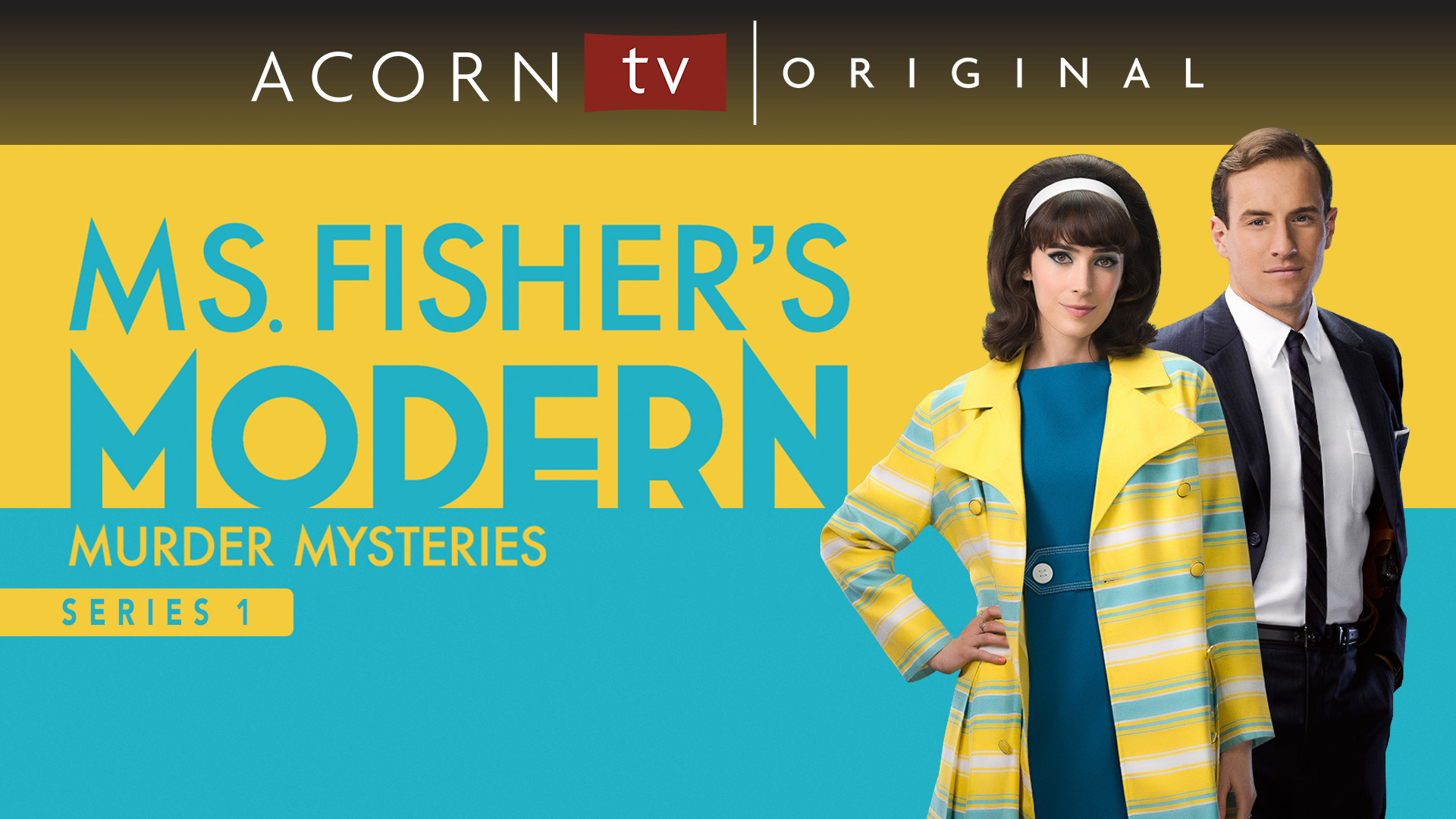
Miss Fishers Modern Murder Mysteries This is a spin-off of the beloved Miss Fisher’s Murder Mysteries, which reinvents the formula with a bright, playful 1960s twist. Peregrine Fisher, the previously unknown niece of the glamorous and legendary Phryne Fisher, unexpectedly finds herself stepping into her aunt’s world of mystery, murder, and high society — and, much to her own surprise, discovers that she has quite the knack for detective work herself. Most of what made the original series so charming remains intact: feisty independent heroine, slow-burn detective romance, the gentle tackling of social issues beneath the glamour, but perhaps most importantly, the kick-ass wardrobe. But where Phryne’s world shimmered with 1920s Art Deco elegance, Peregrine’s explodes with swinging-sixties psychedelic grooviness. This is a world drenched in colour and optimism: mod fashion, glossy hairdos, and enough geometric patterns to make your eyes spin. Peregrine tears around Melbourne in her little Aston Martin, solving murders in go-go boots and impossibly chic mini dresses, looking as though she’s stepped directly off the pages of a vintage fashion magazine. And Peregrine herself is an utter charmer — less polished and worldly than Phryne, but endearingly enthusiastic, impulsive, and eager to prove herself. A far out murder mystery series which glitters with flower power energy and bedazzles with cheeky humour and fun characters.
Inspector George Gently Inspector Gently — a veteran Scotland Yard detective devastated by the murder of his wife — leaves London behind and heads north to Newcastle and the surrounding Geordie landscape in search of a quieter life. What he finds instead is a police force steeped in corruption, casual brutality, and the ingrained prejudices of 1960s Britain. Gently is resolutely old-school in the best sense of the phrase: calm, methodical, deeply principled, and unwavering in his belief that justice must be pursued within the bounds of the law. His new sergeant, John Bacchus, could hardly be more different. Young, arrogant, impulsive, and riddled with the casual racism and sexism of the era, Bacchus is more than willing to bully suspects and bend rules in pursuit of results. Initially, the partnership is combustible. But the relationship between the two men gradually becomes the emotional backbone of the series. Gently regards Bacchus with a mixture of exasperation and reluctant affection, like a troublesome, overgrown puppy in desperate need of discipline and guidance. Bacchus, in turn, slowly matures under Gently’s influence, becoming more thoughtful and self-aware as the years pass. Because the show is set in the 1960s — a world far removed from modern political sensitivities — many of the storylines confront the uglier realities of the time: police corruption, institutional sexism, racism, domestic abuse, and the heavy-handed culture of British policing. Yet while Gently has little patience for fools or bullies within his own ranks, he shows genuine compassion toward society’s most vulnerable, particularly abused women, prostitutes, and those ignored or dismissed by the system. It is a beautifully acted and superbly written, nuanced portrait of a changing Britain which delivers thoughtful, character-driven stories that linger long after the mystery itself is solved.
~Endeavour Endeavour is the brilliantly crafted prequel to Inspector Morse, taking us back to the 1960s when the young Endeavour Morse is only just beginning his career in policing. For longtime fans of Morse, the title alone carries significance: Endeavour is his rarely spoken Christian name, mythically guarded in the original series.Shaun Evans is superb in the titular role, giving us a younger Morse just as we might have imagined — gawky, cerebral, emotionally awkward, and quietly aloof — a man who can solve impossible crimes but fails spectacularly at ordinary human interaction, one who makes colleagues and superiors alike, bristle. And while he already comes across as standoffish, he is not yet arrogant, is a touch more vulnerable, has not yet hardened into the melancholic curmudgeonly-ness of older Morse. Nor does he consume quite as much beer. But his signature weakness for damsels in distress is already in plain view. Poor Morse. Always so unlucky with the ladies! It’s what gives him his mournful air, that soft sadness of the romantically wounded. The series begins in the early part of the 1960’s, when postwar austerity still lingers over Oxford in the form of grey suits, polished shoes, and rigid social hierarchies. Interiors glow with wood paneling, classic cars drive down rain-slick streets, women glide by in sharp sixties silhouettes and elegant eyeliner. The colors are muted retro, the music is classic opera and jazz with bursts of sixties pop. But as the seasons progress, the sixties slowly transform around Morse as youth culture creeps in and social attitudes loosen. The country moves from restraint toward modernity while Morse himself remains curiously out of step with almost all of it. Oxford, of course, is a character in its own right: all dreamy spires, ivy-covered colleges, cobbled streets, and smoky pubs. But the emotional core of the series lies in the relationship between Morse and his superior officer, Inspector Fred Thursday, played magnificently by Roger Allam. Thursday is gruff, decent, instinctive, and deeply humane — an old-school copper trying to navigate a rapidly changing world. He’s frequently baffled by Morse’s strange methods and intellectual eccentricities, yet recognises his brilliance. And for all fans of Morse there are echoes from the future. In the first episode Endeavour sings in a choir, as did Morse in the first episode of the original series, there’s a long meaningful glance at a red Jaguar. and Abigail Thaw — daughter of the original Morse actor John Thaw — plays newspaper editor Dorothea Frazil, a lovely real-world wink to the legacy of the franchise. A beautifully written, exquisitely acted love letter, not only to Morse himself, but to an entire vanished Britain balanced delicately between tradition and change.
The Ipcress Files Not only is this series set in the 1960s, it positively luxuriates in the aesthetics of the decade. Tilted camera angles, washed-out retro palettes, smoky jazz-club atmosphere, and gloriously cheesy fight scenes give the whole series the feel of a lost Cold War thriller unearthed from another era. At its center is Joe Cole as Harry Palmer, a small-time army hustler offered a way out of military prison by joining WOOC(P), a shadowy British intelligence unit headed by the magnificently dry Major Dalby, played with impeccable wit by Tom Hollander. And so Harry gets to be a James Bond-esque character, but without the suave, the cool or the effortless good looks. Instead, he squints his way through thick glasses, carries himself with a working-class cynicism, and radiates the faintly disreputable energy of a man with a deeply shady past. Which makes him far more interesting. Bouncing off this energy is Lucy Boynton as Jean Courtney, a deliciously icy, exceptionally capable intelligence officer portrayed with the cool, razor-sharp sangfroid Boynton does so well. Their chemistry gives the series much of its spark. A remake of the classic film starring Michael Caine, the story revolves around a kidnapped scientist, Cold War paranoia, and the looming threat of the neutron bomb. As the conspiracy deepens, Britain finds itself caught not only against the Soviets, but increasingly at odds with the Americans as well. Dripping with style and atmosphere, the series revels in morally murky intelligence work, simmering tension, and the dead panniest of dead pan humour.
~The Indian Doctor In the summer of 1963, Dr. Prem Sharma and his wife Kamini arrive in a small mining village in Wales where Prem is to take on the post of village doctor. Kamini, whose ideal move to Britain involved London, takes one look at this place in the middle of nowhere and immediately wants to leave. The locals, in turn, are rather bemused to find themselves with a foreigner as a doctor. Prem, Kamini and villagers alike tiptoe their way through a sea of preconceived notions and mutual curiosity with the wonderfully warm culture clash providing plenty of inbuilt humour. In one particularly funny scene, the village snob invites the Sharmas to dinner, nervously asking whether they are comfortable sitting at a dining table rather than on cushions on the floor. She is magnificently humbled when Kamini casually reveals that she comes from a wealthy family in Delhi, grew up with a household full of servants, and has hobnobbed with many of Britian’s elite. It is moments like these that gently puncture the villagers’ assumptions while never turning the show bitter or heavy-handed. At the heart of the series are the performances by Sanjeev Bhaskar and Ayesha Dharker as Prem and Kamini. Bhaskar gives Prem a quiet dignity and kindness that make him instantly likeable — a thoughtful, compassionate man determined to do right by his patients even when confronted with prejudice or resistance. But it’s Dharker who often steals scenes. Kamini arrives glamorous, sharp-tongued, and utterly unimpressed by village life, but beneath her frustration, beneath her beautiful saris lies an enormous emotional intelligence and a dazzling smile that could melt the coldest of hearts. Watching her slowly soften toward the village — and the village toward her — becomes one of the show’s greatest pleasures. What makes the story even richer is that it’s rooted in real history. In the early 1960s, the British government actively recruited doctors from India, Pakistan, and Bangladesh to help address severe staffing shortages in the relatively new National Health Service. Around 18,000 doctors answered the call, and most were well accepted, especially in rural communities where local medical care had been scarce for years. The Indian Doctor uses that history not as heavy political commentary, but as the backdrop for a deeply human story about belonging, adaptation, and community. A portrait of two worlds gradually learning to understand one another: warm, funny, and quietly moving with an old-fashioned gentleness.
Sister Boniface Mysteries This series is set in the gloriously named village of Great Slaughter, where murder rates appear alarmingly high for such an idyllic corner of the English countryside. At the center of it all is Sister Boniface herself, a delightfully unconventional nun with a Ph.D in forensic science and a former life as a codebreaker at Bletchley. Now she rides a bright red scooter, brews wine for the convent, and with her own surprisingly sophisticated crime lab, moonlights as an adviser for the local police department, solving crimes with an enthusiasm that borders on glee. The series is a spin-off from the much-loved Father Brown, although it is perfectly watchable without any prior knowledge of it — I personally have never seen it. It’s a fluffy, cozy show, very much in the vein of Midsomer Murders—neat, tidy and clean-shaven. There’s a merry band of kooky villagers, a beautiful rural backdrop and lots of charming wit. It’s also a little wooden, a lot silly and utterly one dimensional. And yet it can be strangely hard to resist its sweet and quaint escapism that feels almost rebellious, its kindness for humanity, its utter lack of cynicism, and the pull of a nun who is so brightly optimistic and curious. It’s a murder mystery series wrapped in a cup of tea and a freshly baked scone