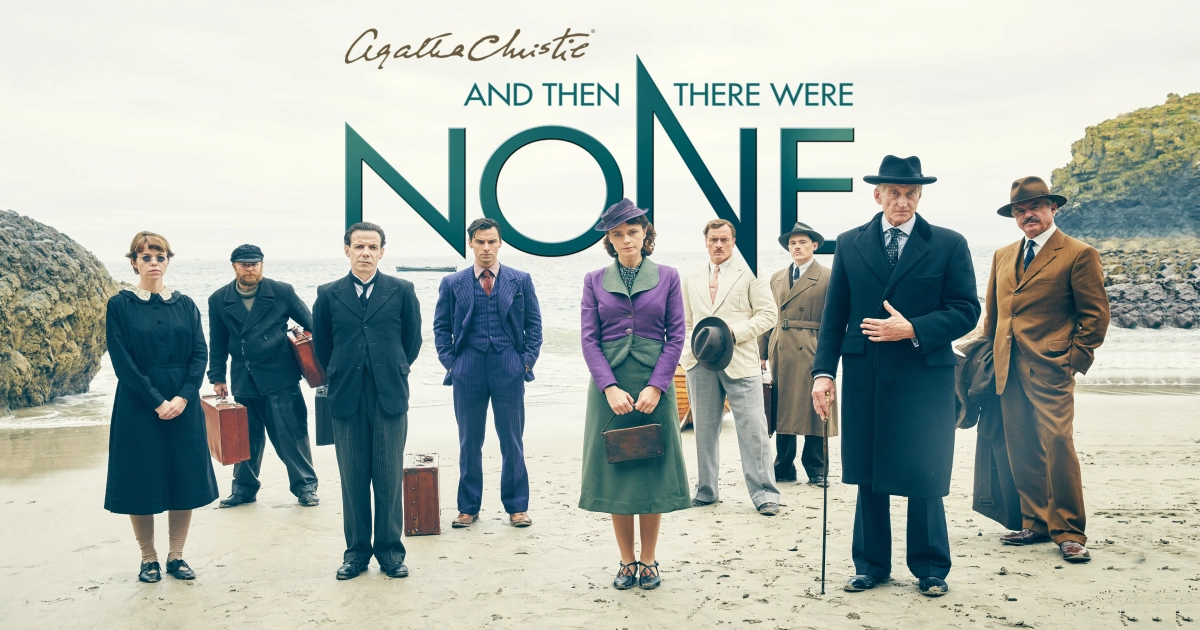
Then There Were None This is the series that kicked off the wave of Christie remakes, back in 2015. And it’s a good one. It’s also Christie’s most famous, most popular novel, with its clever, excellently constructed mystery set in a grand house on a remote island off the coast of Devon. Ten strangers find themselves brought together under mysterious circumstances, morbidly amused, at first, by the nursery rhyme relating the deaths of “Ten Little Soldier Boys” which is taped to the wall in each of their rooms. On their first evening, awkwardly getting to know each other and wondering where their host is, amusement gives way to shock as a gramophone recording relays the dark secret they each harbor—a past death for which they suffered no consequence. Soon shock curdles to terror as, one by one, the guests begin to die in the same way as the nursery rhyme. Through a series of flash backs we are shown the extent of their past actions, the depths of their guilt, their moral decay. And while outside a storm rages, inside, mutual suspicion takes hold as accusations fly and aspersions are cast. It quickly becomes clear that no-one is innocent on this island and no-one is safe. And Then There Were None is visually stunning, quietly moody and stylish, and is just the right tone of eerily sinister throughout, with an absolutely stellar ensemble cast—Aidan Turner, Charles Dance, Miranda Richardson, Toby Stephens, Anna Maxwell Martin, Sam Neill. Brilliant all.
The Pale Horse A mysterious list of names is discovered hidden in the shoe of a woman who collapses and dies while staggering toward a police station. One of those names belongs to Mark Easterbrook (Rufus Sewell), a widowed antiques dealer still haunted by the death of his first wife, Delphine, and now remarried to Hermia. Disturbed and intrigued, Mark sets out to uncover why his name is there—an investigation that leads him to The Pale Horse, a secluded house in the beautiful village of Much Deeping, home to three women rumored to be witches capable of eliminating people via supernatural means. While initially skeptical, Mark’s certainty erodes as those on the list start dying in ways that appear natural, yet feel deeply suspicious. When someone close to him turns up dead and another man on the list insists the witches are behind it all, Mark’s world begins to fracture and he begins a slow-burning descent into paranoia. His dreams are haunted, his dread intensifies, his wife becomes agitated and suspicious. All of this plays out against a fabulously stylish 60’s backdrop with film noir-ish vibes and a whisper of the gothic —foggy, isolated, and suffocatingly intimate.
The ABC Murders Hercule Poirot is a shadow of his former self. His glory days are behind him, Inspector Japp has, sadly, just shuffled from this mortal coil and Captain Hastings is nowhere in sight—leaving Poirot isolated, diminished, and quietly adrift. When he begins receiving a series of taunting letters predicting murders in specific locations, each signed “A.B.C.,” he turns to the police for help, only to be not just dismissed, but ridiculed. Indeed, Poirot is forced to endure a myriad of tiny humiliations. But then Alice Ascher of Andover is killed, followed by Betty Barnard of Bexhill, a pretty young waitress whose death garners more attention. The game is now afoot, and as the pattern unfolds, Inspector Crome reluctantly joins forces with Poirot in a race against time to stop the next killing. The case grows more unsettling when Poirot realizes he has personal connections to each location, and it begins to feel that the murderer understands him intimately.The pace is slow and deliberate and leans heavily into moody, broody, melancholic nostalgia. Through flashbacks, we learn of Poirot’s last tragic days in Belgium, an experience that has shaped his life as a refugee and deepened his sense of displacement and when he connects once again with a family he knew in years prior, it adds deeper layers of reflection and regret. Poirot is not just a man chasing a killer, but a man grappling with his own personal history of trauma and loss. John Malkovich is excellent as Poirot.
Ordeal By Innocence The wealthy Argyll family—Rachel, Leo, and their five adopted children—might appear to embody privilege and stability at first glance, but on Christmas Eve, any illusion is shattered when Rachel is brutally murdered in her own home. Suspicion falls almost immediately on troubled “black sheep” of the family, Jack. Unable to prove his alibi, he is swiftly convicted and later dies in prison, the case seemingly closed. Eighteen months later, with just days before Leo is set to marry the much younger Gwenda, a knock at the door brings the past rushing back: Dr. Arthur Calgary arrives with the startling revelation that he can verify Jack’s alibi. Jack, it seems, could not have been the killer, throwing the household into disarray. Old tensions reignite, jealousy simmers, and long-buried resentments begin to surface. Through a series of flashbacks, we see glimpses of the siblings, who seem, at various points, to be close-knit, but they have all been shaped by a complicated relationship with their mother. Rachel’s own brittle perfection has resulted in rigid standards and emotional neglect which has left deep, lasting scars on all of them. But even Rachel’s intentions prove more complex than they first appear. As the story unfolds, skeletons are dragged, one by one, from the proverbial cupboard, revealing a web of pain and misunderstandings. This adaptation stands out as one of the most complex, layered and emotionally nuanced, offering a deeper exploration of all its characters, including Dr. Calgary and the longtime housekeeper, Kirsten, who plays her own role in the family dynamics. By the end, nothing is quite as it seems. Lots of outstanding performances by familiar faces—Eleanor Tomlinson plays an overwrought, anxious sibling, Matthew Goode her nasty husband, Anna Chancellor is Rachel, and, my personal fave, Bill Nighy is Leo, in a role which feels particularly suited to him.